

Cart is empty
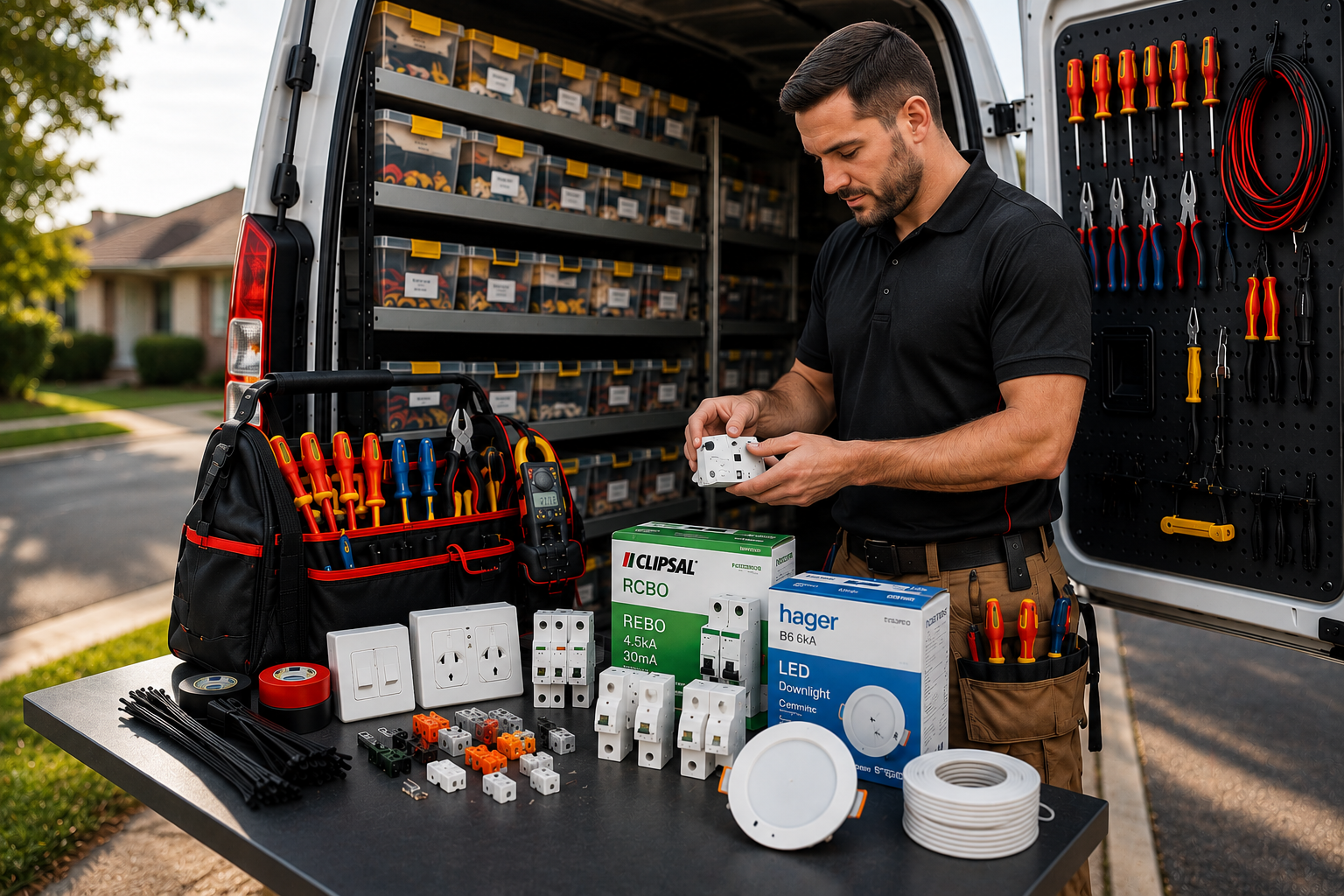
For an Electrician, time on the road can quickly become time away from the job. A forgotten connector, missing cable accessory or unavailable replacement component can mean an unnecessary trip to the wholesaler, a delayed installation or an unhappy customer.
That is why a well-organised electrical van is more than a storage space. It is a working inventory that helps electricians respond faster, complete more jobs and reduce unnecessary supplier runs.
This Electrician Tools van stock checklist for Australia explains what electricians should consider keeping in their vehicles, how to organise van stock and how to decide which products deserve permanent space.
Whether you are an apprentice building your first setup, a residential electrician, a commercial contractor or a maintenance electrician, the right van stock system can make your working day considerably more efficient.
What Should Every Electrician Keep in Their Van?
Every electrician should carry a practical selection of frequently used consumables, cable accessories, switches, power points, circuit protection components, testing equipment and job-specific materials.
The exact stock will depend on the type of electrical work you perform. A residential electrician may need different products from a commercial or industrial contractor, so the goal is not to carry everything.
The goal is to carry the products you use frequently enough to justify keeping them available.
A useful approach is to divide your electrical van stock into three levels:
- Must-Have Stock – products used regularly on most jobs
- Job-Dependent Stock – products required for particular types of work
- Backup Stock – replacement items and emergency supplies that prevent unnecessary return trips
This system keeps your van useful without turning it into an overloaded mobile warehouse.
1. Electrical Consumables
Consumables are some of the easiest items to overlook because they are inexpensive and relatively small. However, they are also among the products electricians can run out of most quickly.
Consider maintaining a minimum stock of:
- Electrical insulation tape
- Cable ties
- Heat shrink
- Cable markers
- Electrical connectors
- Terminals and lugs
- Screws and fixings
- Cable clips
- Glands
- WAGO-style connectors
- Labels and identification materials
- Batteries for compatible equipment
- Cable glands
- Conduit fittings
- Junction boxes
- Saddles
- Bushes
- Adaptors
- Flexible conduit accessories
- Other cable management components
- Standard power points
- Single and double power points
- Common light switches
- Switch mechanisms
- Blank plates
- Weatherproof accessories
- USB-integrated power points
- Selected premium or designer accessories
- Spare mounting components
- RCBOs
- MCBs
- RCDs
- Safety switches
- Circuit protection accessories
- Switchboard components
- Common cable accessories
- Glands
- Terminals
- Cable identification products
- Conduit accessories
- Protective components
- Voltage testers
- Multimeters
- Test leads
- Insulation resistance testing equipment
- Clamp meters
- Other electrical test instruments
- LED downlights
- LED battens
- Replacement lamps where relevant
- Emergency lighting components
- Lighting accessories
- Common mounting accessories
- Connectors and installation accessories
- Common switches
- Power points
- Circuit protection components
- Connectors
- Cable accessories
- Electrical tape
- Cable ties
- Batteries
- Common lighting products
- Weatherproof accessories
- Common terminals
- Common power points
- Common switches
- Frequently used cable accessories
- LED downlights
- Power points
- Switches
- Cable accessories
- Emergency lighting products
- Commercial lighting accessories
- Circuit protection components
- Cable management products
- Replacement switches
- Power points
- Connectors
- Common circuit protection components
These products take up little space but can be essential for completing an installation.
A good van-stock system should have a minimum quantity for high-use consumables. When the quantity drops below that level, add the item to your next electrical supplies order rather than waiting until it is completely gone.
2. Cable Management Accessories
Cable management products are another important part of everyday electrical work.
Depending on your trade and the projects you handle, your van may benefit from carrying commonly used:
The right accessories help keep installations organised and make it easier to complete small changes or repairs without returning to the wholesaler.
AGM Electrical Supplies offers a broad range of electrical products and accessories suitable for electricians, contractors and trade customers across Australia.
3. Switches and Power Points
Switches and Power Points are common requirements across residential maintenance, renovations and new installations.
Depending on your typical jobs, consider carrying a small selection of commonly requested configurations.
Your stock could include:
You do not need to carry every colour and configuration.
Instead, identify the products you install most frequently and keep those as your core van stock.
For less common finishes or specialised products, ordering them before the job is usually more practical than carrying them permanently.
4. Circuit Protection Components
Circuit Protection products can become particularly important during maintenance work and switchboard upgrades.
Depending on your licence, work type and project requirements, commonly used products may include:
However, electricians should always select products according to the specific installation, equipment requirements and applicable Australian regulations and standards.
Do not treat a van-stock checklist as a substitute for electrical design, testing or compliance requirements.
For safety-critical components, the correct product matters more than simply having something available in the van.
5. Wiring and Cable Accessories
Cable and wiring requirements can vary significantly from one project to another.
Rather than trying to carry every cable size, electricians can use their previous jobs to identify the cable types and accessories they regularly require.
Useful van-stock items may include:
For larger cable requirements, project-specific ordering is generally more practical because of the amount of space cable can consume.
The principle is simple:
Keep frequently used accessories in the van and plan larger material requirements around the job.
6. Testing and Electrical Safety Equipment
A productive van needs more than installation materials.
Testing equipment and safety-related gear should be maintained carefully and checked regularly according to manufacturer requirements and applicable workplace procedures.
Depending on the work being performed, electricians may use equipment such as:
Test equipment should be suitable for the intended application and maintained appropriately.
Electricians should also follow their workplace safety procedures and applicable Australian requirements when carrying, using and storing electrical testing equipment.
7. LED Lighting and Common Lighting Accessories
LED Lighting jobs can change quickly.
A customer may ask for an additional fitting, a replacement downlight or an upgrade while you are already on site. Having commonly used lighting products available can help reduce delays.
Depending on your regular work, consider stocking:
Your lighting stock should reflect the jobs you actually perform.
For example, an electrician specialising in residential renovations may carry more commonly used downlights, while a commercial contractor may prioritise battens, emergency lighting and other commercial products.
8. Emergency and Replacement Stock
One of the biggest benefits of a well-planned van is being prepared for unexpected situations.
Maintenance electricians and service contractors can particularly benefit from carrying a small emergency stock of commonly required replacement items.
This could include:
The objective is not to predict every possible fault.
It is to prevent a small and predictable problem from becoming an unnecessary second trip.
The 3-Level Electrical Van Stock System
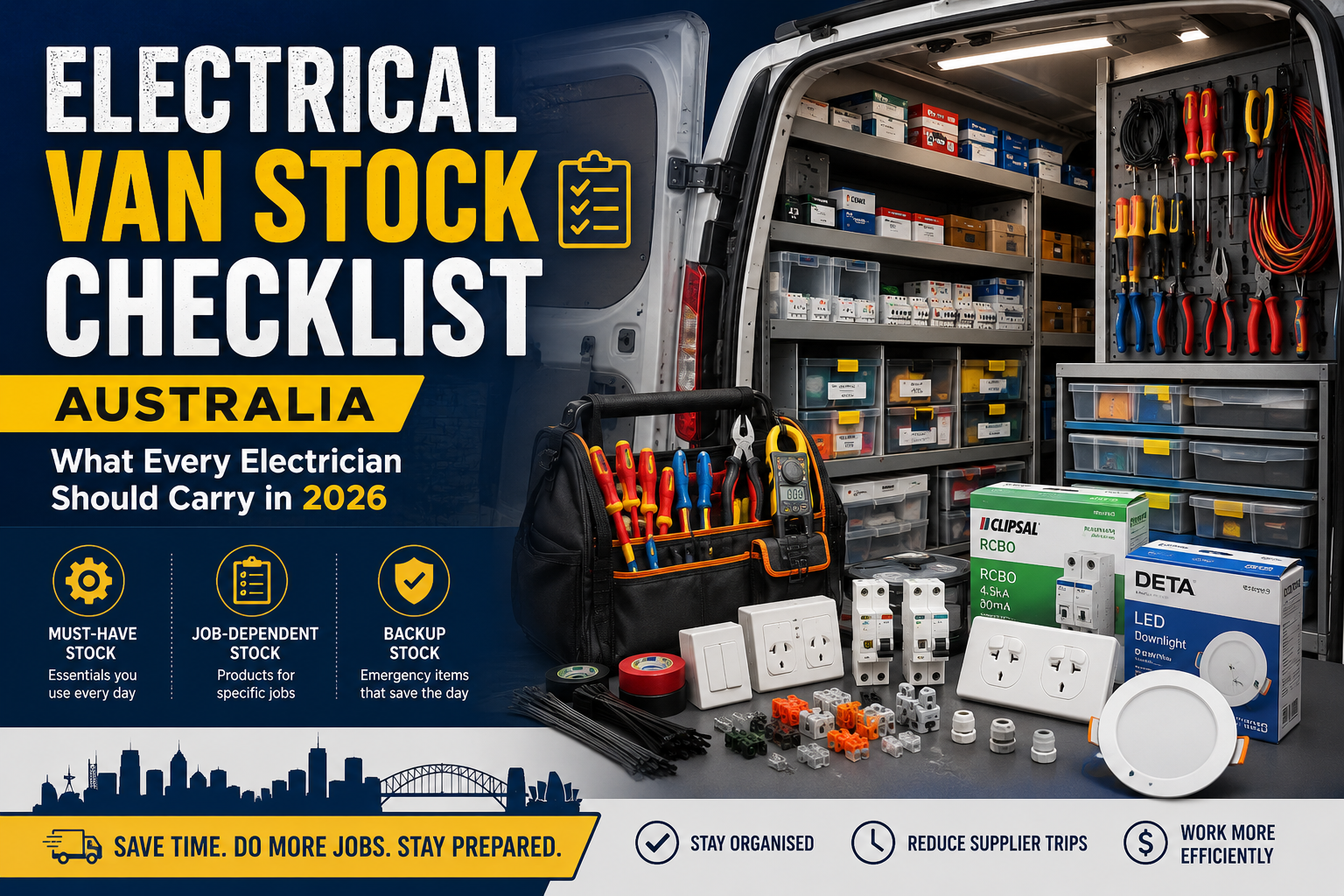
Level 1: Must-Have Stock
These are products you use frequently.
Examples include:
These items should be checked regularly.
Level 2: Job-Dependent Stock
These products depend on the type of work scheduled.
For example:
Residential renovation
Commercial work
Maintenance work
Move job-dependent products into the van when they are relevant to the next project.
Level 3: Backup Stock
Backup stock is designed for unexpected situations.
Keep a limited quantity of products that can save a return trip when something changes on site.
However, avoid filling your van with products that rarely get used.
Unused stock takes up space and ties up money.
How to Organise Electrical Van Stock
A good inventory system is just as important as the products themselves.
Instead of putting everything into one large toolbox, organise products into clearly labelled sections.
For example:
Drawer 1 – Consumables
Tape, cable ties, heat shrink and connectors.
Drawer 2 – Cable Accessories
Glands, clips, saddles, conduit fittings and junction accessories.
Drawer 3 – Switches & Power Points
Common switches, GPOs and accessories.
Drawer 4 – Circuit Protection
Frequently required breakers and protection components.
Drawer 5 – Lighting
Common LED products and lighting accessories.
Drawer 6 – Small Fixings
Screws, terminals, lugs and other small components.
This makes it easier to identify what you have without emptying the entire van.
Create Minimum Stock Levels
One of the simplest ways to improve van inventory is to establish a minimum stock level.
For example:
Electrical tape
Minimum: 3 rolls
When stock reaches 3 rolls, add it to the next order.
Cable ties
For an Electrician, time on the road can quickly become time away from the job. A forgotten connector, missing cable accessory or unavailable replacement component can mean an unnecessary trip to the wholesaler, a delayed installation or an unhappy customer.
That is why a well-organised electrical van is more than a storage space. It is a working inventory that helps electricians respond faster, complete more jobs and reduce unnecessary supplier runs.
This Electrician Tools van stock checklist for Australia explains what electricians should consider keeping in their vehicles, how to organise van stock and how to decide which products deserve permanent space.
Whether you are an apprentice building your first setup, a residential electrician, a commercial contractor or a maintenance electrician, the right van stock system can make your working day considerably more efficient.
How to Organise Electrical Van Stock
A good inventory system is just as important as the products themselves.
Instead of putting everything into one large toolbox, organise products into clearly labelled sections.
For example:
Drawer 1 – Consumables
Tape, cable ties, heat shrink and connectors.
Drawer 2 – Cable Accessories
Glands, clips, saddles, conduit fittings and junction accessories.
Drawer 3 – Switches & Power Points
Common switches, GPOs and accessories.
Drawer 4 – Circuit Protection
Frequently required breakers and protection components.
Drawer 5 – Lighting
Common LED products and lighting accessories.
Drawer 6 – Small Fixings
Screws, terminals, lugs and other small components.
This makes it easier to identify what you have without emptying the entire van.
Create Minimum Stock Levels
One of the simplest ways to improve van inventory is to establish a minimum stock level.
For example:
Electrical tape
Minimum: 3 rolls
When stock reaches 3 rolls, add it to the next order.
Cable ties
Minimum: 2 packs
When one pack is opened, check whether another pack needs to be ordered.
The exact quantities should be based on your usage rather than arbitrary numbers.
Track the products you use over several weeks and identify which items disappear fastest.
Those are the products that deserve permanent space in your van.
How Often Should You Check Your Electrical Van Stock?
A quick stock check should be part of your normal routine.
A practical approach is:
Daily
Check the products used heavily during the day’s jobs.
Weekly
Perform a complete van-stock check.
Monthly
Review which products are:
- Frequently used
- Rarely used
- Overstocked
- Missing
- Expired or damaged
- Taking up unnecessary space
- Less available storage
- More time searching for products
- Higher inventory costs
- Increased risk of damaged products
- More weight in the vehicle
- Money tied up in slow-moving stock
- Electrical tape
- Cable ties
- Cable clips
- Connectors
- Heat shrink
- Basic fixings
- Common accessories
- Marking and labelling supplies
- Appropriate testing equipment
- Tool and component storage
- Power points
- Switches
- LED downlights
- Cable accessories
- Connectors
- Cable ties
- Electrical tape
- Common circuit protection components
- Weatherproof accessories
- Lighting accessories
- Cable management
- Circuit protection
- Commercial lighting
- Emergency lighting
- Switchboard components
- Conduit accessories
- Identification and labelling products
- Job-specific electrical components
- You use frequently
- Have a long shelf life
- Take little storage space
- Have predictable demand
- Are cheaper per unit when purchased in quantity
- Storage space
- Cash tied up in inventory
- Product turnover
- Manufacturer or product chang
- Conduit fittings
- Junction accessories
- Bushes
- Adaptors
- Common switches
- Power points
- Blank plates
- Weatherproof accessories
- Selected specialty accessories
- Frequently used MCBs
- RCBOs
- RCD/safety switch products
- Relevant accessories
- Common LED downlights
- LED battens
- Lighting accessories
- Emergency lighting products where relevant
- Voltage tester
- Multimeter
- Test leads
- Required test equipment
- Batteries/chargers
- Screws
- Fixings
- Markers
- Labels
- Storage boxes
- PPE and safety equipment required for the work
- Have not been used for months
- Are damaged
- Are obsolete
- Are duplicated unnecessarily
- Belong to a completed project
- Take up excessive space
- Are better ordered specifically for a job
- Which products did you use repeatedly?
- Which items did you unexpectedly run out of?
- Which products required a supplier run?
- Which items remained unused?
- Which products could have saved time if they were already in the van?
This turns van stock from an afterthought into a simple inventory system.
Don’t Overstock Your Electrical Van
More stock does not always mean better preparation.
An overloaded van can create several problems:
Instead, focus on high-use, low-space and high-value products.
Large or specialised materials should generally be planned around individual projects.
Your van should support your work — not become a warehouse.
Electrical Van Stock for Apprentices
Apprentices do not need to immediately build a fully stocked professional van.
Start with the essentials you use regularly and gradually expand your inventory as you gain experience.
A basic apprentice setup may include:
Ask experienced electricians which products they use repeatedly.
Your stock will naturally become more efficient as you work across different jobs.
Electrical Van Stock for Residential Electricians
Residential electricians typically deal with a broad range of maintenance, renovation and installation work.
A residential-focused van may prioritise:
The exact selection should be based on your typical residential jobs.
If you regularly install a particular product range, keeping common variants available can reduce unnecessary supplier runs.
Electrical Van Stock for Commercial Electricians
Commercial work can require a different inventory strategy.
Depending on the project, commercial electricians may need greater emphasis on:
Large commercial projects should be planned using a project-specific material list rather than relying solely on permanent van stock.
How Can Electricians Reduce Trips to the Electrical Wholesaler?
The best way to reduce unnecessary supplier trips is to combine three things:
1. Know your fast-moving products
Identify what you use repeatedly.
2. Maintain minimum stock levels
Reorder before common items completely run out.
3. Prepare for the next day’s jobs
Review upcoming work before leaving the workshop or home.
This simple process can turn last-minute supplier runs into planned replenishment.
Online electrical ordering can also make replenishment easier when products are available for delivery.
When Should You Buy Van Stock in Bulk?
Bulk purchasing can make sense for products that:
However, bulk buying is not automatically cheaper.
Before buying large quantities, consider:
For slow-moving products, project-specific purchasing is often the better option.
A Simple Weekly Electrical Van Stock Checklist
Use this checklist at the end of each working week.
Consumables
Cable Accessories
Switches & Power
Circuit Protection
Lighting
Tools & Testing
General
What Should You Remove From Your Van?
A van-stock audit should not only identify what is missing.
It should also identify what should be removed.
Consider removing or relocating products that:
A leaner van is usually easier to organise and faster to work from.
Build Your Van Stock Around Your Work
There is no universal electrical van stock list that works perfectly for every Australian electrician.
A domestic service electrician, commercial contractor, maintenance electrician and security installer can all have completely different requirements.
The best van stock system is based on your actual work history.
Look at your last 20–30 jobs.
Identify:
Use that information to build your permanent stock.
This turns your van inventory into a data-driven system rather than a random collection of electrical products.
Conclusion
A well-stocked electrical van is not about carrying every electrical product you might possibly need.
It is about carrying the right products at the right quantities.
Start with high-use consumables, cable accessories, common switches and power points, circuit protection components, lighting products and essential testing equipment. Then create job-specific stock for upcoming projects and maintain a small backup inventory for unexpected requirements.
Most importantly, review your stock regularly.
The electricians who understand their most frequently used materials can spend less time searching for products, reduce unnecessary supplier trips and keep jobs moving.
For Australian electricians and electrical contractors looking for reliable electrical supplies, AGM Electrical Supplies provides a broad range of electrical products across lighting, switches, power points, circuit protection, electrical accessories, security and other trade categories.
Build your van around the work you actually do, keep your fast-moving essentials replenished, and let your stock system work for you.
Frequently Asked Questions
What should every electrician keep in their van?
Every electrician should consider carrying frequently used consumables, cable accessories, common switches and power points, suitable circuit protection components, lighting accessories and appropriate testing equipment. The exact stock should depend on the electrician’s work type.
What electrical consumables should electricians carry?
Common consumables include electrical tape, cable ties, heat shrink, connectors, terminals, cable markers, labels, fixings and other small installation accessories.
How do I organise electrical van stock?
Divide stock into clearly labelled categories such as consumables, cable accessories, switches and power points, circuit protection, lighting and tools. Use minimum stock levels to identify when products need replenishment.
How can electricians reduce trips to the wholesaler?
Track frequently used products, establish minimum stock levels, review upcoming jobs and replenish common items before they run out. Project-specific materials should be planned before starting larger installations.
Should electricians buy electrical supplies in bulk?
Bulk buying can make sense for frequently used products with predictable demand and sufficient shelf life. However, slow-moving or specialised products are generally better purchased for specific projects.
What should a first-year electrician have in their van?
A first-year electrician should focus on essential consumables, cable accessories, common fixings, suitable tools and required testing equipment rather than trying to carry a complete range of electrical products.
How often should electrical van stock be checked?
A quick check can be performed regularly, with a more complete inventory review at least weekly. A monthly review can help identify slow-moving, damaged or unnecessary stock.
Does every electrician need the same van stock?
No. Van stock should reflect the electrician’s work. Residential, commercial, industrial, maintenance and specialist electricians can all require different products.











Recent posts
SMS, Wechat and Whatsapp Contact Details:
For quotes, orders or to get the latest product and pricing news
PLEASE NOTE: We Do Not ANSWER Phone Calls (messages only) and We only respond during business hours.-
Mobile for SMS only

-
Text Message on Whatsapp
 scan Me
 -
Text Message on WeChat
 Wechat ID: agmelectrical
 scan Me

× ![]()